Cuneo Fiscale 2026: The Tax-Free Sum and €1,000 Detrazione Explained
If your RAL is under €40,000, part of your net pay in 2026 comes from the cuneo fiscale, and most payslips never label it clearly. Below €20,000 it arrives as a small tax-free sum added to your pay. Between €20,000 and €40,000 it’s an extra €1,000 detrazione that cuts your IRPEF instead. Same goal, two completely different mechanics, and that’s why two colleagues on similar salaries can see different effects.
Here’s how both parts work, how much they’re worth at different salaries, and what to check on your busta paga and CU. If you just want your own number, run it through the calcolatore stipendio netto.
The Short Version
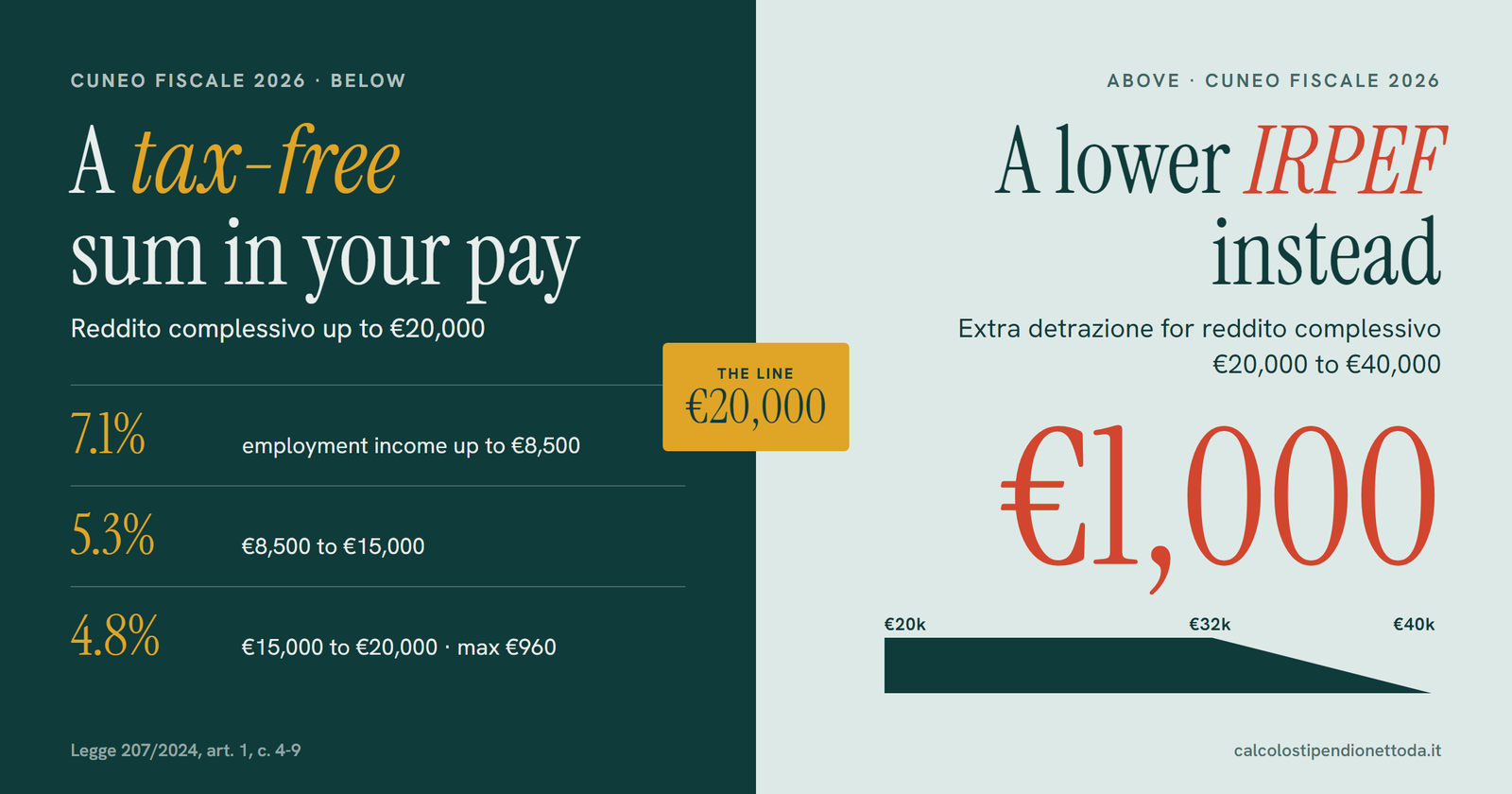
- Reddito complessivo up to €20,000: you get a tax-free sum equal to 7.1%, 5.3% or 4.8% of your employment income. It’s added to your pay and isn’t taxed.
- Reddito complessivo €20,000 to €32,000: you get an extra €1,000 detrazione off your IRPEF for a full year of work.
- €32,000 to €40,000: the €1,000 shrinks in a straight line and hits zero at €40,000.
- Above €40,000: nothing from this measure.
- Who: employees (lavoro dipendente). Pensioners are excluded.
- How: your employer applies it automatically every month, then checks it at the conguaglio.
What the Cuneo Fiscale Is in 2026
“Cuneo fiscale” literally means the tax wedge: the gap between what your employment costs and what lands in your account. Since 2025 the cut to that wedge for employees no longer comes from lower INPS contributions (the old “decontribuzione”). It comes through the tax system instead, under articolo 1, commi 4 to 9, of Legge 207/2024, the 2025 budget law. The measure applies from 2025 onward, so it’s still fully in force for 2026 pay.
That switch matters for how it shows up. Your INPS line on the payslip is the normal 9.19% again. The benefit moves to the tax lines, either as an untaxed extra amount or as a lower IRPEF.
Under €20,000: The Tax-Free Sum
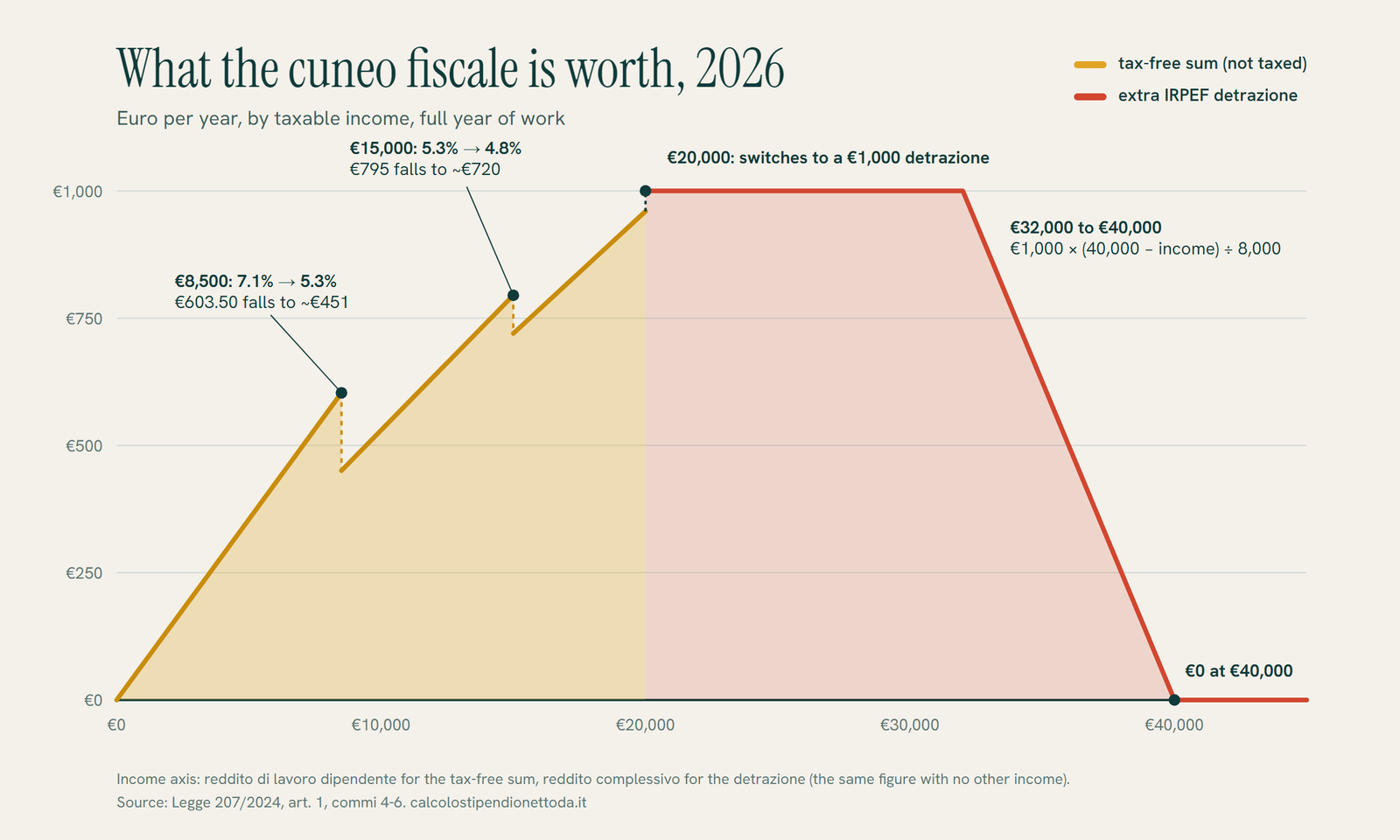
If your reddito complessivo is €20,000 or less, you get a sum that doesn’t count as income at all. It’s calculated on your reddito di lavoro dipendente (your taxable employment income, so RAL minus INPS contributions), using one percentage for the whole amount:
| Reddito di lavoro dipendente | Percentage | Maximum sum |
|---|---|---|
| Up to €8,500 | 7.1% | €603.50 |
| €8,500.01 to €15,000 | 5.3% | €795.00 |
| €15,000.01 to €20,000 | 4.8% | €960.00 |
Two details catch people out:
- The percentage applies to the whole income, not in slices. So there are small cliffs. At exactly €8,500 the sum is €603.50, but at €8,600 it’s €455.80. At €15,000 it’s €795, and just above it drops to about €720.
- Part-year workers are annualised for the percentage only. If you worked six months and earned €9,000, your income is treated as €18,000 to pick the band (4.8%), and then 4.8% is applied to the €9,000 you actually earned.
Because the sum isn’t taxed, it reaches your pocket in full. On a €12,000 RAL that’s roughly €578 a year, about €48 a month.
€20,000 to €40,000: The Extra €1,000 Detrazione
Above €20,000 of reddito complessivo, the tax-free sum stops and an ulteriore detrazione takes over. It reduces your IRPEF directly:
| Reddito complessivo | Extra detrazione (full year) |
|---|---|
| €20,000.01 to €32,000 | €1,000 |
| €32,000.01 to €40,000 | €1,000 × (40,000 − reddito) ÷ 8,000 |
| Above €40,000 | €0 |
So at €36,000 of reddito complessivo it’s €500, and at €38,000 it’s €250. The detrazione is rapportata al periodo di lavoro: work half the year and you get half.
Unlike the sum below €20,000, this is a detrazione, so it only helps if you have enough IRPEF to cut. On salaries in this range that’s almost never a problem.
Which Income Counts
The €20,000, €32,000 and €40,000 thresholds use your reddito complessivo, which is all your income for IRPEF purposes, not just your salary. A few rules from comma 9:
- Income from your main home (abitazione principale) and its pertinenze is left out.
- If you’re on the impatriati or rientro ricercatori regime, the exempt part of your income still counts toward the thresholds.
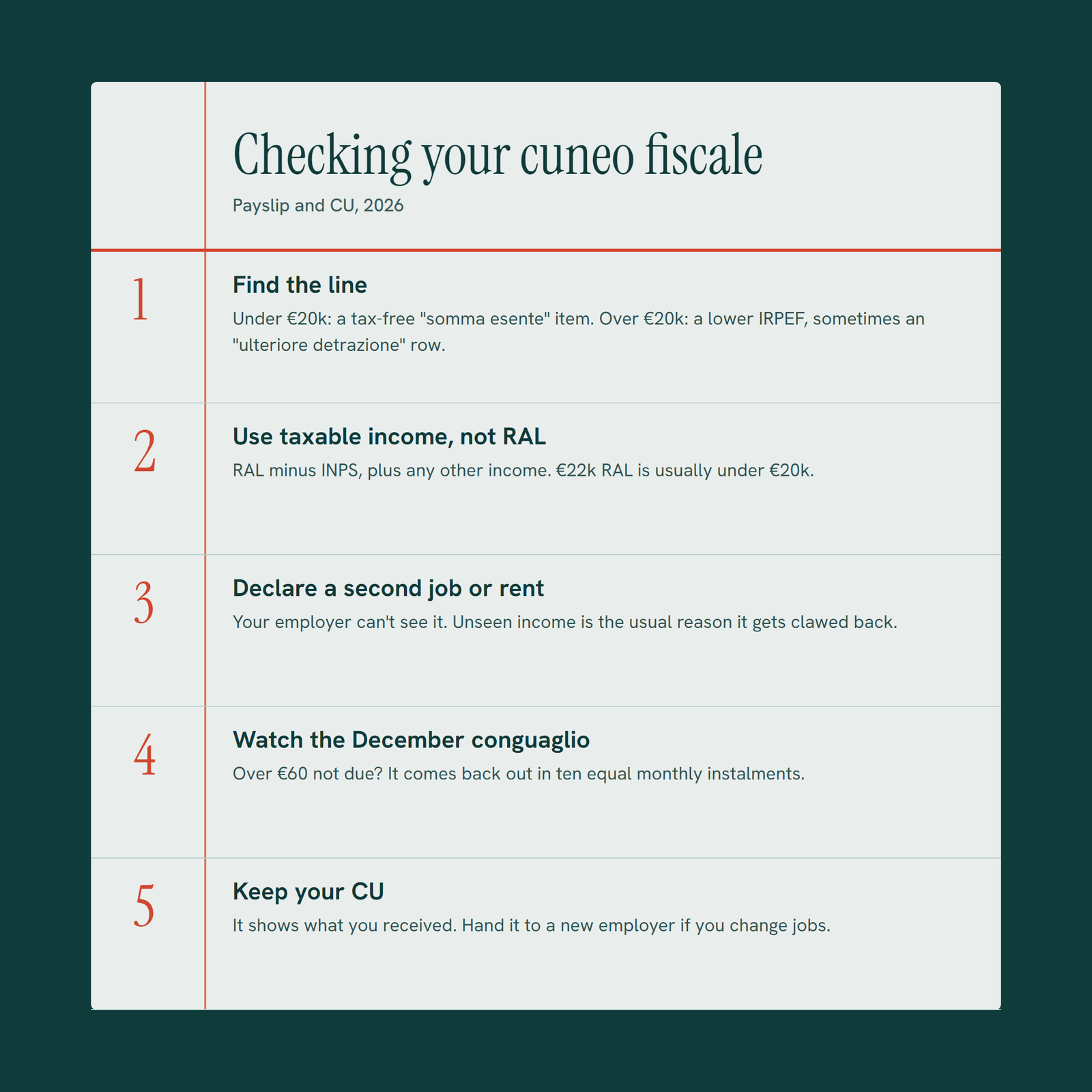
- Other income your employer doesn’t know about (rent, a second job, freelance work) counts too. That’s the most common reason the cuneo gets taken back later.
Pensioners are excluded, because the law limits it to employees under article 49 of the TUIR and carves out pension income.
What It’s Worth: Six Salaries
These are full-year figures for a private-sector employee with no other income, using INPS at 9.19%, the 2026 IRPEF brackets (23% to €28,000, 33% to €50,000) and the standard detrazione for lavoro dipendente. Regional and municipal addizionali are left out, as is the separate trattamento integrativo, which low earners may also get.
| RAL | Taxable income | Cuneo type | Cuneo per year | Per month (÷12) | Net before addizionali |
|---|---|---|---|---|---|
| €12,000 | €10,897 | Tax-free sum 5.3% | €578 | €48 | €10,924 |
| €18,000 | €16,346 | Tax-free sum 4.8% | €785 | €65 | €16,347 |
| €22,000 | €19,978 | Tax-free sum 4.8% | €959 | €80 | €18,986 |
| €30,000 | €27,243 | Detrazione €1,000 | €1,000 | €83 | €24,021 |
| €38,000 | €34,508 | Detrazione, reduced | €687 | €57 | €28,017 |
| €45,000 | €40,864 | None | €0 | €0 | €30,972 |
Note the €22,000 row. A RAL of €22,000 still lands under €20,000 of taxable income once INPS comes off, so it gets the tax-free sum, not the detrazione. The thresholds are about taxable income, not RAL.
Worked Example: €30,000 RAL
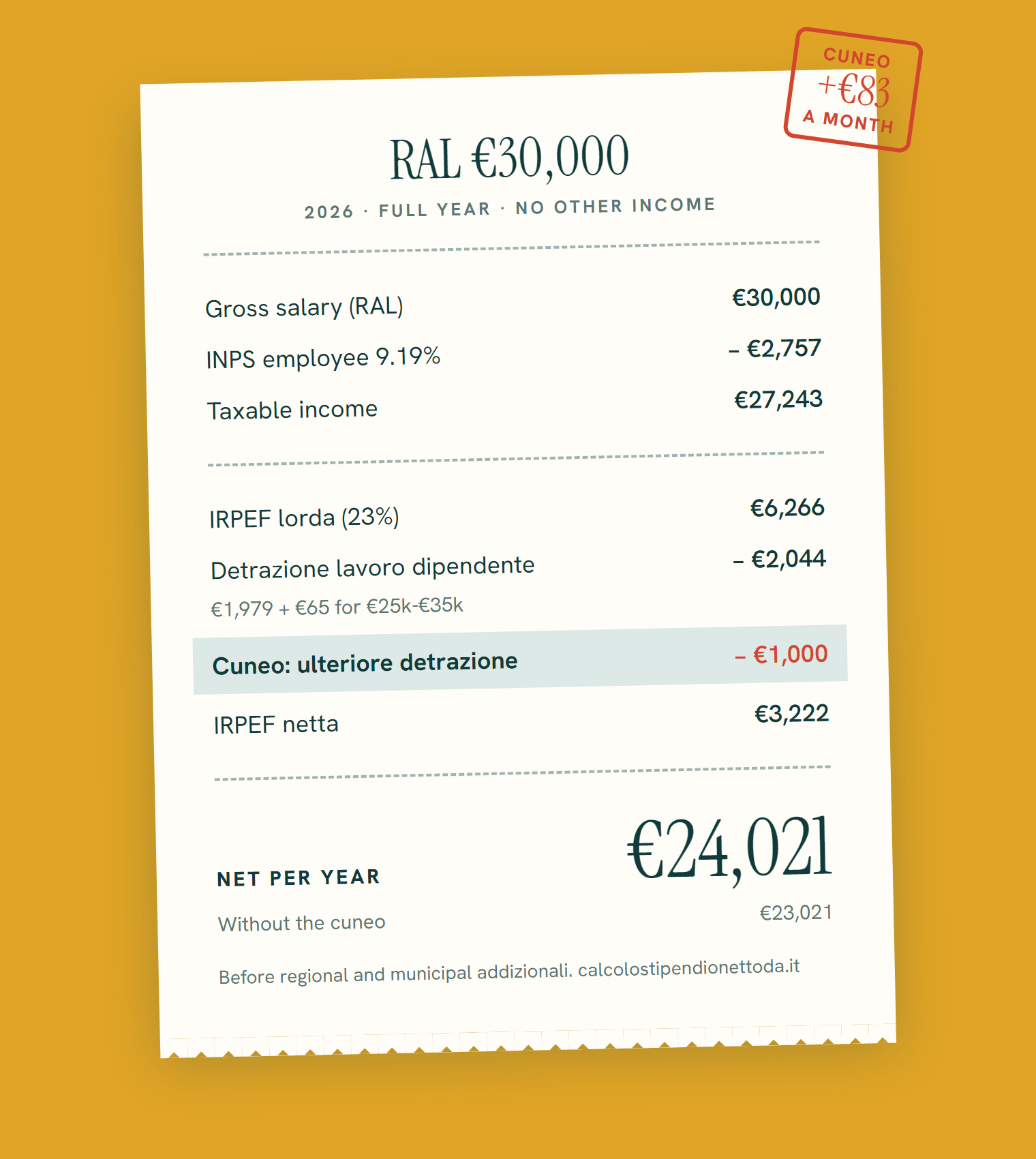
Here’s the full calculation for a €30,000 RAL with no other income:
- INPS (9.19%): €2,757. Taxable income is €27,243.
- IRPEF lorda: 23% of €27,243 = €6,266.
- Detrazione lavoro dipendente: €1,910 + €1,190 × (28,000 − 27,243) ÷ 13,000 = €1,979, plus the €65 bonus for incomes between €25,000 and €35,000, so €2,044.
- Cuneo, ulteriore detrazione: €1,000.
- IRPEF netta: €6,266 − €2,044 − €1,000 = €3,222.
- Net before addizionali: €30,000 − €2,757 − €3,222 = €24,021.
Without the cuneo, that net would be €23,021. The measure is worth about €83 a month on twelve paychecks.
How It Shows Up on Your Busta Paga
Your employer (the sostituto d’imposta) applies the cuneo automatically when paying your salary. You don’t need to ask for it. Where to look:
- Under €20,000: a separate line, usually called something like “somma esente cuneo fiscale” or “trattamento cuneo L. 207/2024”, among the non-taxable items added to your pay. The exact wording depends on the payroll software.
- Over €20,000: no extra line in the earnings. The €1,000 is folded into the detrazioni, so your IRPEF line is simply lower. Some payslips show “ulteriore detrazione” in the tax section.
If you can’t find it, our guide on how to read a busta paga walks through the sections, and trattenute in busta paga covers the tax lines in detail.
When It Gets Taken Back
Your employer only sees the salary it pays you. At the conguaglio (December, or when you leave the job) it checks whether you were really entitled. If it turns out you weren’t, for example because you got a raise that pushed you over a threshold, it recovers the amount.
- Under €60: taken back in one go.
- Over €60: spread across ten equal monthly instalments, starting with the first payslip after the conguaglio.
If the problem is income your employer never knew about, the adjustment happens in your 730 or Redditi PF instead, and it can mean paying some back. The amounts you received appear in your CU (Certificazione Unica), so the Agenzia delle Entrate can check them.
This is also why a raise sometimes feels smaller than expected: crossing €32,000 starts eating into the €1,000. We cover that effect in why a raise doesn’t feel like a raise.
Two Jobs, Changing Jobs, Part-Time
- Two jobs at once: each employer only sees its own salary, so both may apply the cuneo. Tell at least one of them about the other income, or expect to settle it in your tax return.
- Changing jobs mid-year: give your new employer your CU from the old one so they can do a single conguaglio. Otherwise the check happens in your 730.
- Part-time: the tax-free sum’s percentage is chosen on annualised income, but the €1,000 detrazione is cut in proportion to the days you worked over the year, not your hours. A full-year part-timer gets the full €1,000 if their income falls in the band.
What Changes in 2027
The new Testo Unico delle imposte sui redditi (D.Lgs. 19 giugno 2026, n. 117) reorganises income-tax law and takes effect on 1 January 2027. As part of that recodification, comma 6 of Legge 207/2024 (the extra €1,000 detrazione) is repealed. The tax-free sum in comma 4 is not on the repeal list. How the new code handles the detrazione from 2027 isn’t something we’ve been able to confirm yet, so don’t plan your 2027 pay around the figures here. For 2026 salaries, nothing changes: everything above applies until 31 December 2026, and we’ll update this guide when the 2027 treatment is clear.
Frequently Asked Questions
What is the cuneo fiscale in 2026?
It’s a tax cut for employees with reddito complessivo up to €40,000. Up to €20,000 you get a tax-free sum of 7.1%, 5.3% or 4.8% of your employment income. From €20,000 to €32,000 you get an extra €1,000 detrazione, which falls to zero between €32,000 and €40,000.
Do I need to apply for the cuneo fiscale?
No. Your employer applies it automatically when paying your salary and checks it at the conguaglio.
Is the cuneo fiscale taxed?
The sum paid below €20,000 is not taxed and does not count as income. Above €20,000 the benefit is a detrazione, so it lowers the tax you pay rather than being paid as a separate amount.
Do pensioners get the cuneo fiscale?
No. The law covers employees only and excludes pension income.
Is the €20,000 limit based on my RAL?
No. It’s based on your reddito complessivo, which for most employees is RAL minus INPS contributions, plus any other income. A RAL of €22,000 is usually under €20,000 of taxable income.
How much is the cuneo fiscale on a €30,000 salary?
On a €30,000 RAL with no other income, it’s an extra €1,000 detrazione for the year, about €83 a month.
Why was the cuneo fiscale taken back from my pay?
At the conguaglio your employer found you weren’t entitled to all of it, usually because your income went over a threshold. Amounts over €60 are recovered in ten equal monthly instalments.
Does the cuneo fiscale still apply in 2027?
For 2026 salaries it applies in full. From 1 January 2027 the new Testo Unico (D.Lgs. 117/2026) repeals the clause for the extra €1,000 detrazione, and how it is handled after that has not been confirmed yet, so check the 2027 rules before relying on the same figures.
Conclusion
The 2026 cuneo fiscale is worth up to €1,000 a year, but how you get it depends on which side of €20,000 of taxable income you sit. Below it, look for a tax-free line on your payslip. Above it, the benefit hides inside a lower IRPEF. Either way, keep your employer informed about other income so it isn’t clawed back in ten instalments next year. To see the effect on your own pay, try the calcolatore stipendio netto, and if your net still looks low, read why your net salary is lower than expected.
Disclaimer and Sources
This guide is general information, not tax advice. Figures are for 2026 salaries, assume a full year of work with no other income, and leave out addizionali and the trattamento integrativo. Payroll treatment can vary with your contract and your employer’s software. Last checked: 6 October 2026.