Calcolo TFR 2026: How Your Severance Pay Is Calculated and Taxed (With Calculator)
Your TFR (trattamento di fine rapporto) is the severance pay your employer sets aside for you every year and pays out when you leave the job. For many people it’s the biggest single payment they’ll ever receive from an employer, yet few know how much they’ve actually built up or how much tax they’ll pay on it.
This guide explains exactly how TFR is calculated under Italian law, how the yearly revaluation works, how it’s taxed, and gives you a calculator to estimate your own. For your monthly take-home pay, use our calcolatore stipendio netto.
TFR Calculator
Enter your annual salary, years of service and an inflation assumption. The calculator estimates your gross TFR, the revaluation, and the tax withheld when it’s paid out.
Estimate only. Assumes the same salary and inflation every year, 2026 IRPEF brackets, and no anticipi. The Agenzia delle Entrate later recalculates the tax using your average rate of the previous five years.
What Is TFR?
TFR is regulated by article 2120 of the Italian Civil Code. Every employee in the private sector builds up TFR for each year worked, and the employer pays it when the employment ends for any reason: resignation, dismissal or retirement. It’s sometimes called “liquidazione”.
Since 2007, workers can choose to send their future TFR to a fondo pensione (supplementary pension fund) instead of leaving it with the employer. At companies with 50 or more employees, TFR left “in azienda” is transferred to a treasury fund run by INPS, though for you it works the same way. This guide covers TFR left with the employer or the INPS treasury fund.
How TFR Is Calculated
Step 1: the yearly quota
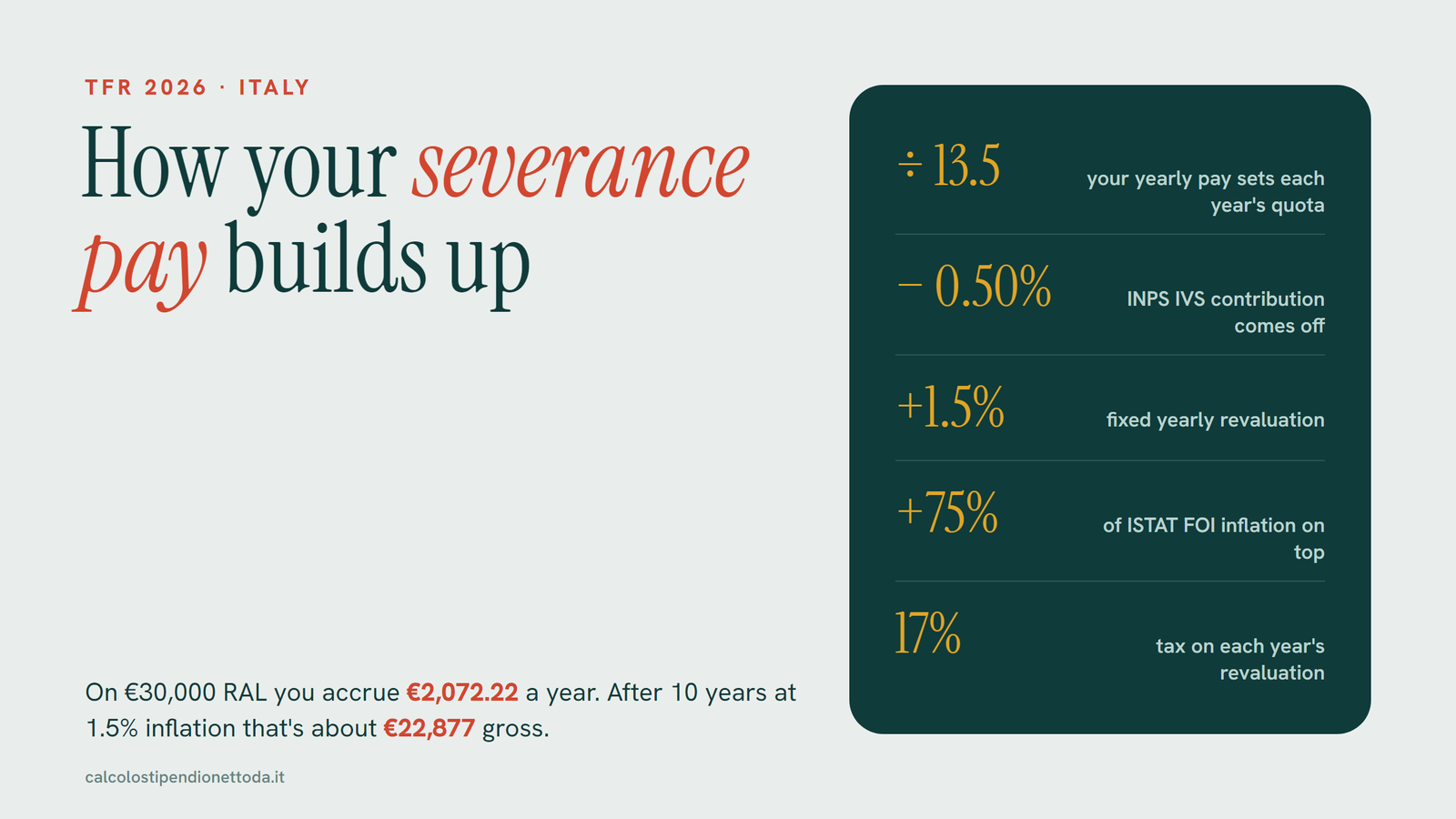
Each year, your TFR quota is your retribuzione annua utile divided by 13.5. That’s roughly one month’s pay per year worked. From that amount, the employer deducts the 0.50% contribution to INPS (contributo aggiuntivo IVS) calculated on the same pay.
So on a RAL of €30,000: €30,000 ÷ 13.5 = €2,222.22, minus 0.50% of €30,000 (€150) = €2,072.22 a year.
| Annual pay (RAL) | Pay ÷ 13.5 | Minus 0.50% IVS | TFR per year |
|---|---|---|---|
| €20,000 | €1,481.48 | €100.00 | €1,381.48 |
| €25,000 | €1,851.85 | €125.00 | €1,726.85 |
| €30,000 | €2,222.22 | €150.00 | €2,072.22 |
| €40,000 | €2,962.96 | €200.00 | €2,762.96 |
| €50,000 | €3,703.70 | €250.00 | €3,453.70 |
“Retribuzione utile” usually means all regular, non-occasional pay, including tredicesima and quattordicesima, unless your CCNL says otherwise. Expense reimbursements don’t count.
Step 2: the yearly revaluation
On 31 December each year, the TFR you’ve built up so far (not counting that year’s new quota) is revalued by 1.5% fixed plus 75% of the increase in the ISTAT FOI consumer price index over the previous December. If inflation was 2%, the revaluation rate is 1.5% + 1.5% = 3%.
The revaluation is taxed separately every year with a 17% imposta sostitutiva, which the employer withholds. So what you keep is 83% of each year’s revaluation.
How TFR Is Taxed
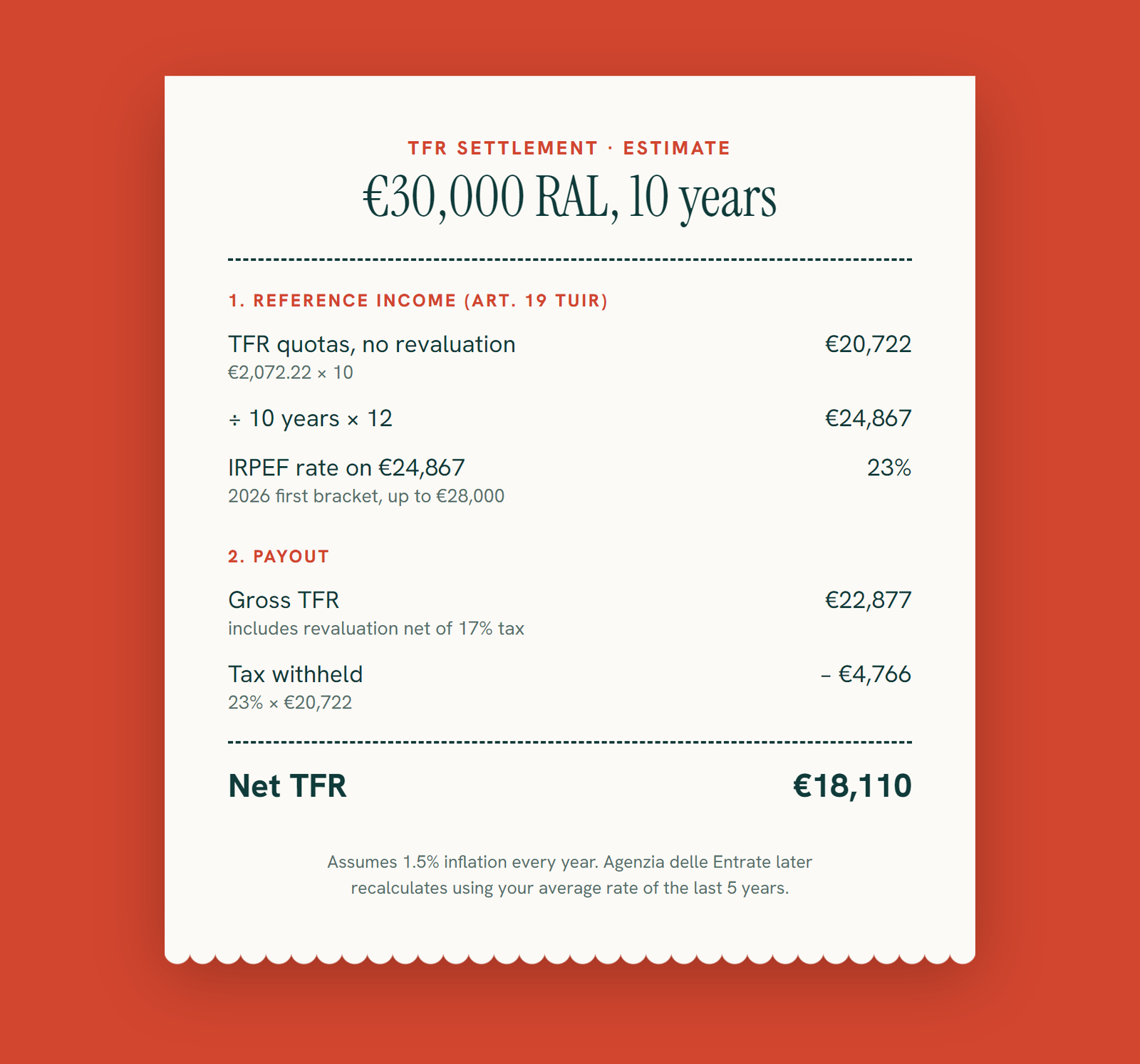
TFR isn’t taxed like your normal salary. It falls under tassazione separata (separate taxation) under article 19 of the TUIR. The employer works out a provisional tax rate like this:
- Take the TFR, excluding revaluations already taxed at 17%.
- Divide it by your years of service and multiply by 12. This gives a “reference income”.
- Apply the normal IRPEF brackets to that reference income (23% up to €28,000, 33% up to €50,000, 43% above, for 2026).
- The resulting average rate is applied to your whole TFR.
Later, the Agenzia delle Entrate recalculates the tax using your average tax rate over the five years before the TFR became due, then either refunds the difference or asks for more. For most employees on ordinary salaries the final rate lands close to the provisional one, but it can move either way.
Worked Examples
These assume the same salary every year and 1.5% average inflation. Figures are rounded to the nearest euro.
| Example | Gross TFR | Revaluation (gross) | Tax rate | Tax withheld | Net TFR |
|---|---|---|---|---|---|
| €25,000 RAL, 5 years | €9,019 | €463 | 23% | €1,986 | €7,033 |
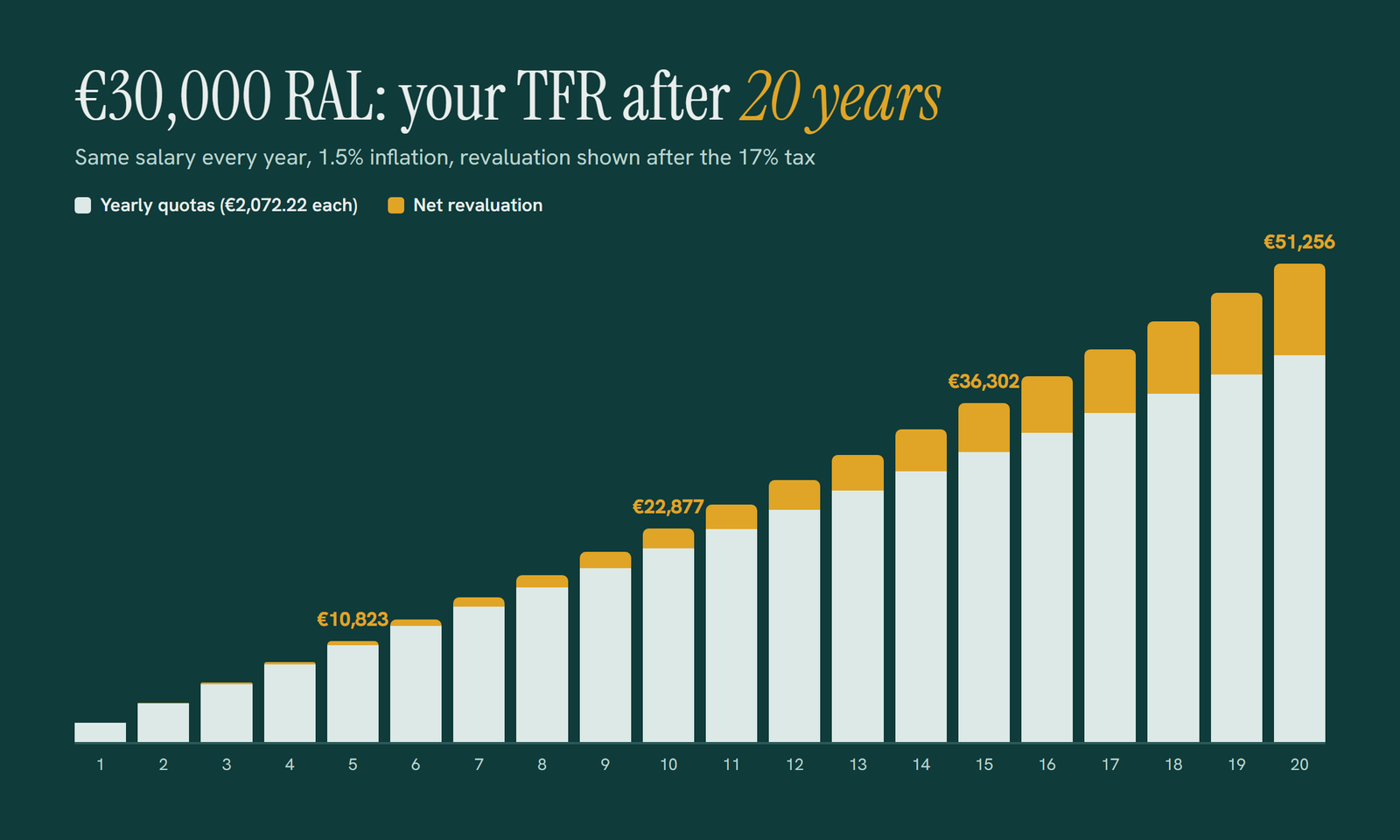
| €30,000 RAL, 10 years | €22,877 | €2,596 | 23% | €4,766 | €18,110 |
| €45,000 RAL, 20 years | €76,883 | €17,731 | 25.5% | €15,848 | €61,035 |
Gross TFR already includes the revaluation after the 17% tax. The tax withheld is the separate-taxation amount on the quotas only.
Can You Get Your TFR Early?
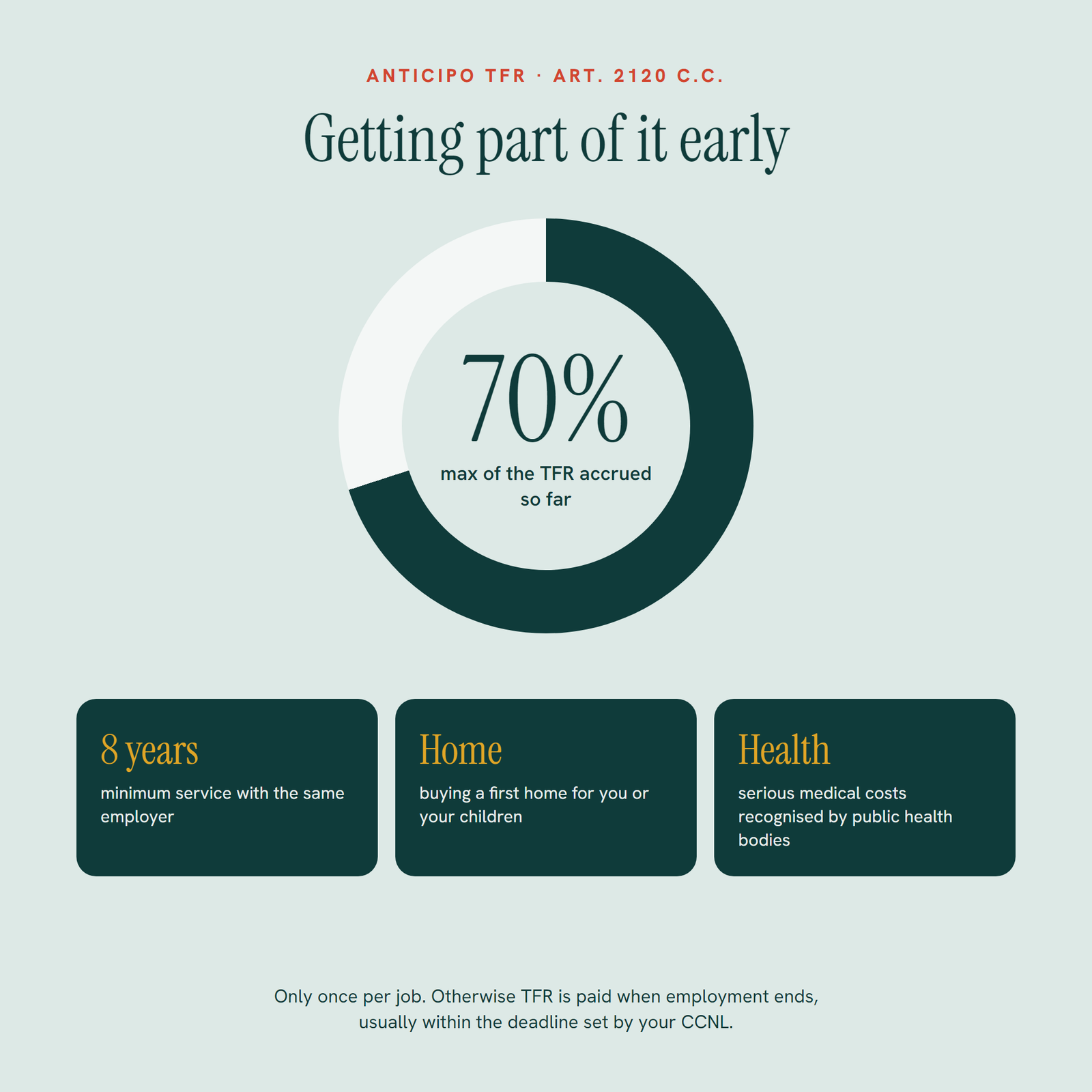
Yes, in some cases. Under article 2120, after at least eight years with the same employer you can request an anticipo of up to 70% of the TFR accrued, for serious medical expenses or to buy a first home for yourself or your children, among other reasons set by law or your CCNL. You can get it only once per job, and employers only have to grant a limited number of requests each year (10% of eligible staff, capped at 4% of the workforce).
When Is TFR Paid?
TFR is paid when your employment ends. Most CCNLs set a time limit, often within the month after you leave or a few months at most. Check your contract and your last busta paga, where TFR usually appears as a separate line. If you’re not sure how to read it, see our guide to trattenute busta paga.
Disclaimer e Fonti
This guide and calculator give estimates only. Real TFR depends on your exact pay each year, the actual ISTAT revaluation coefficients, any anticipi already taken, contributions to a pension fund, and your CCNL. The tax figure is the employer’s provisional withholding; the Agenzia delle Entrate makes the final calculation. For your situation, check your busta paga or ask a CAF or consulente del lavoro.
Sources: article 2120 of the Codice Civile on Normattiva; article 19 of the TUIR (DPR 917/1986); INPS on the treasury fund and the 0.50% contribution; Assolombarda on the revaluation rules. IRPEF brackets for 2026 per Legge 199/2025.