Conguaglio di Fine Anno 2026: Why Your December Payslip Changes
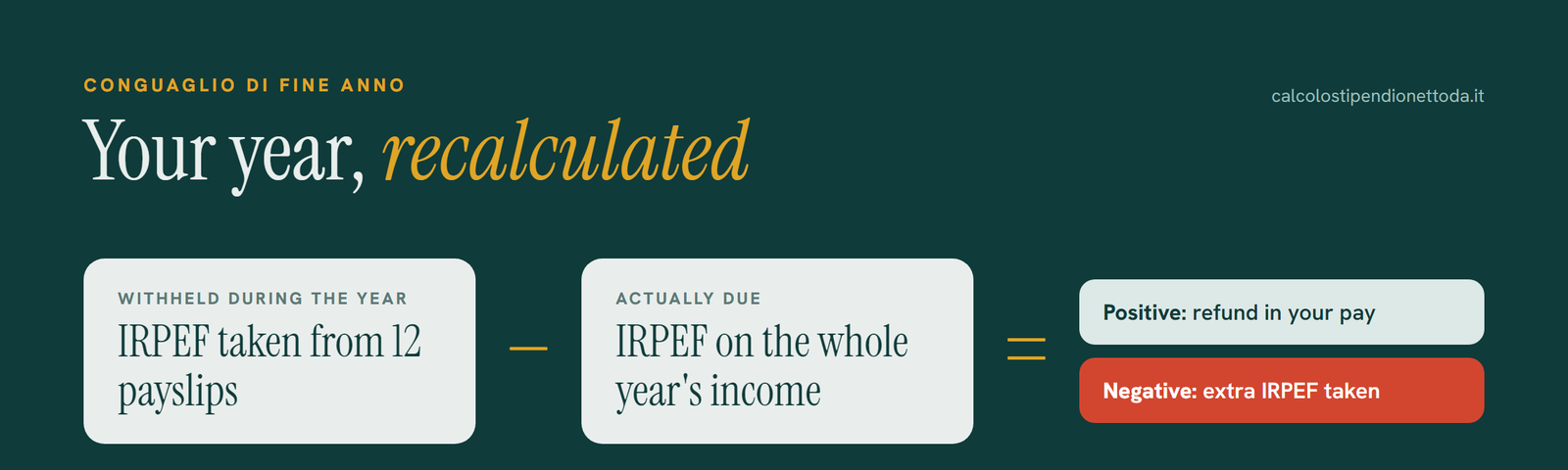
Every December, a lot of Italian employees open their busta paga and find something odd: a big extra IRPEF line, or sometimes a nice refund. Both come from the same place, the conguaglio di fine anno. It’s the moment your employer looks back at the whole year and checks whether the tax taken from your monthly pay was actually right.
Here’s what the conguaglio is, why it can take money from you (or give it back), the legal deadlines, and what happens if your December pay isn’t enough to cover it. All examples use 2026 rules.
What Is the Conguaglio di Fine Anno?
During the year, your employer (the sostituto d’imposta) withholds IRPEF from each payslip. Those monthly withholdings are estimates. They’re based on what you earned that month and on the detrazioni you’re expected to be entitled to over the year.
At the end of the year, the employer has to redo the sum properly. Under art. 23 of DPR 600/1973, it compares the total tax withheld with the tax actually due on your whole year’s pay, after the detrazioni of the TUIR. The difference is settled in the conguaglio:
- If too much was withheld, you get a refund (a conguaglio a credito).
- If too little was withheld, the extra is taken from your pay (a conguaglio a debito).
When the Conguaglio Happens
| Situation | When it is done |
|---|---|
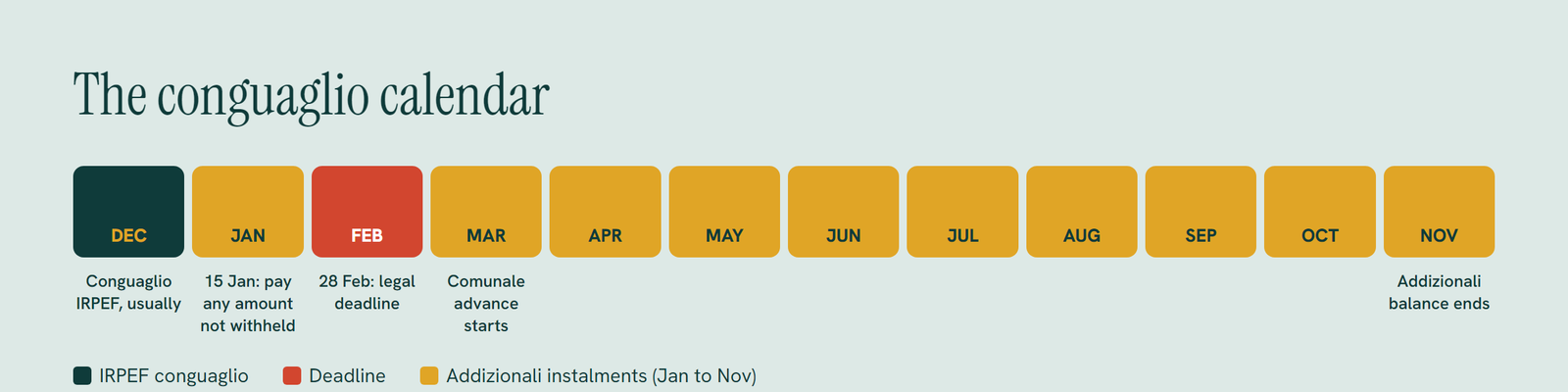
| Normal case | Usually in the December payslip, and in any case by 28 February of the following year |
| Your job ends during the year | At the time the employment ends (cessazione del rapporto) |
| You want income from a previous job counted | You must give the employer the CU from that job so it can include it |
Most payroll offices do it in December, because that’s when the year’s figures are final. Some do it in January or February, which the law allows.
Why the Conguaglio Can Take Money From You
The most common reason is simple: your annual income ended up different from what payroll assumed, and your detrazioni shrink as income rises. The art. 13 TUIR detrazione for employees falls gradually from about €28,000 of income, and the cuneo fiscale detrazione of €1,000 starts tapering above €32,000 and disappears at €40,000. If a bonus, overtime or a pay rise pushes you higher, some of the detrazioni you received month by month have to be given back.
Other common causes:
- A one-off bonus or arrears late in the year that raise your total income.
- Detrazioni per familiari a carico that you claimed but no longer qualify for, for example because a family member’s income went over the limit.
- Two jobs in the same year, if you ask the second employer to combine them. Each employer on its own taxes you as if it were your only income.
- The under-€20,000 tax-free sum (somma esente) from the cuneo fiscale, if your final income ends up outside the range where it applies.
Worked Example: A €6,000 Bonus in December
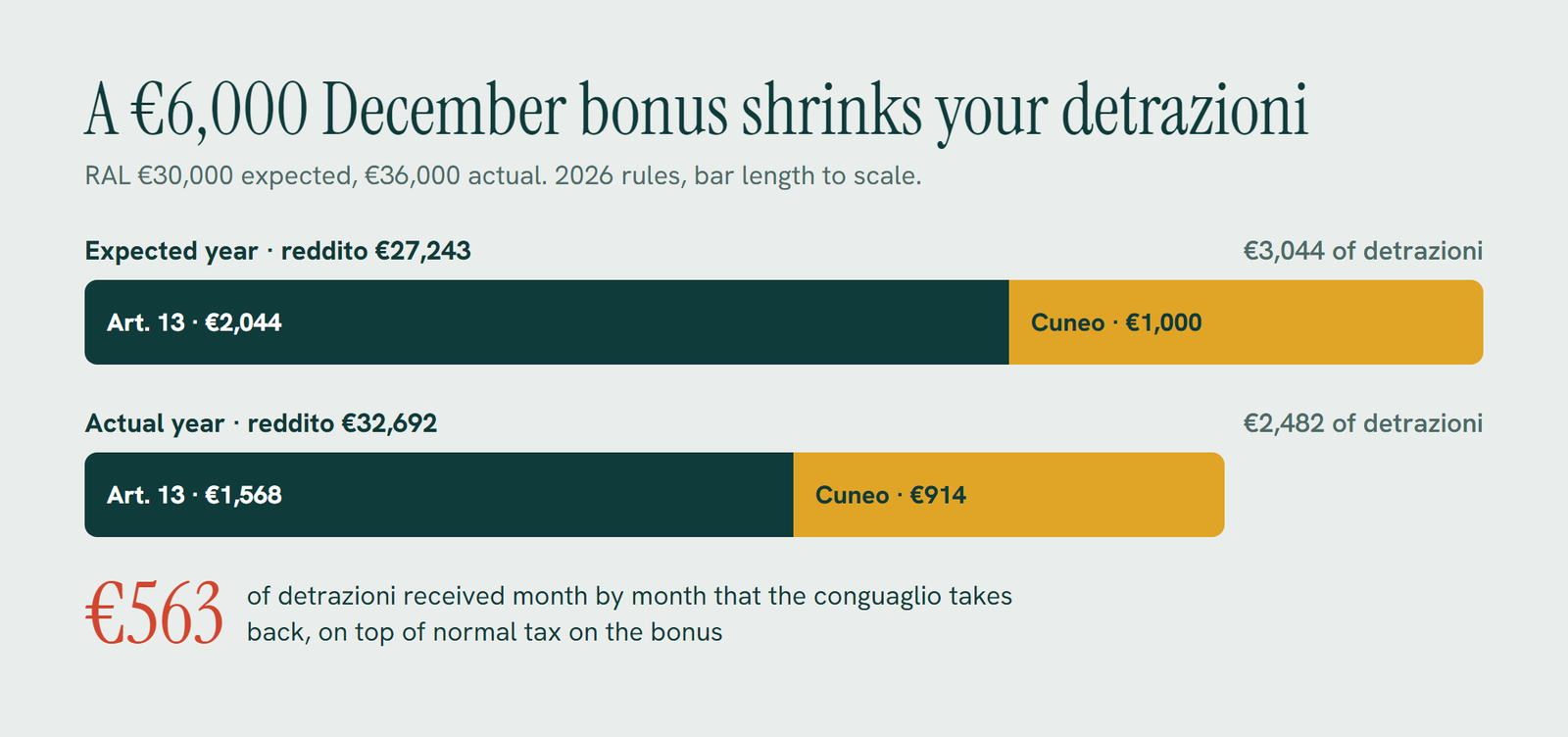
Take an employee on a RAL of €30,000 who gets an unexpected €6,000 bonus in December, so the year’s gross becomes €36,000. Here’s how the detrazioni change, using 2026 rules (INPS at 9.19%, so taxable income is gross minus contributions):
| Expected year (€30,000) | Actual year (€36,000) | |
|---|---|---|
| Reddito imponibile | €27,243 | €32,692 |
| IRPEF lorda | €6,266 | €7,988 |
| Detrazione lavoro dipendente (art. 13) | €2,044 | €1,568 |
| Detrazione cuneo fiscale | €1,000 | €914 |
| IRPEF netta for the year | €3,222 | €5,507 |
The detrazioni fall by about €563 between the two cases. If payroll had been applying detrazioni as if the year would end at €30,000, that €563 is what the conguaglio recovers in December, on top of the normal tax on the bonus itself. This is simplified (it isolates the detrazioni effect), but it shows why a December payslip can look much lower than expected even when you earned more.
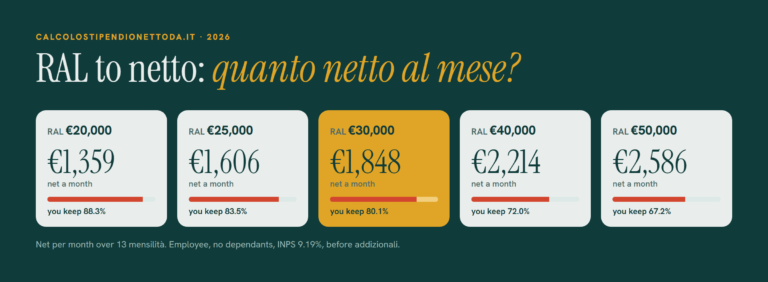
To see what your normal net pay looks like at different salaries, check our RAL to netto table, and for the €1,000 detrazione and tax-free sum, see our guide to the cuneo fiscale.
Why the Conguaglio Can Give You Money Back
A conguaglio a credito usually happens when your income ended up lower than expected (unpaid leave, part-time, a period off work), or when you told your employer about new detrazioni during the year, such as a child born or a family member becoming dependent. In those cases you paid too much tax month by month, and the difference comes back in your pay.
What If Your Pay Isn’t Enough? (Incapienza)
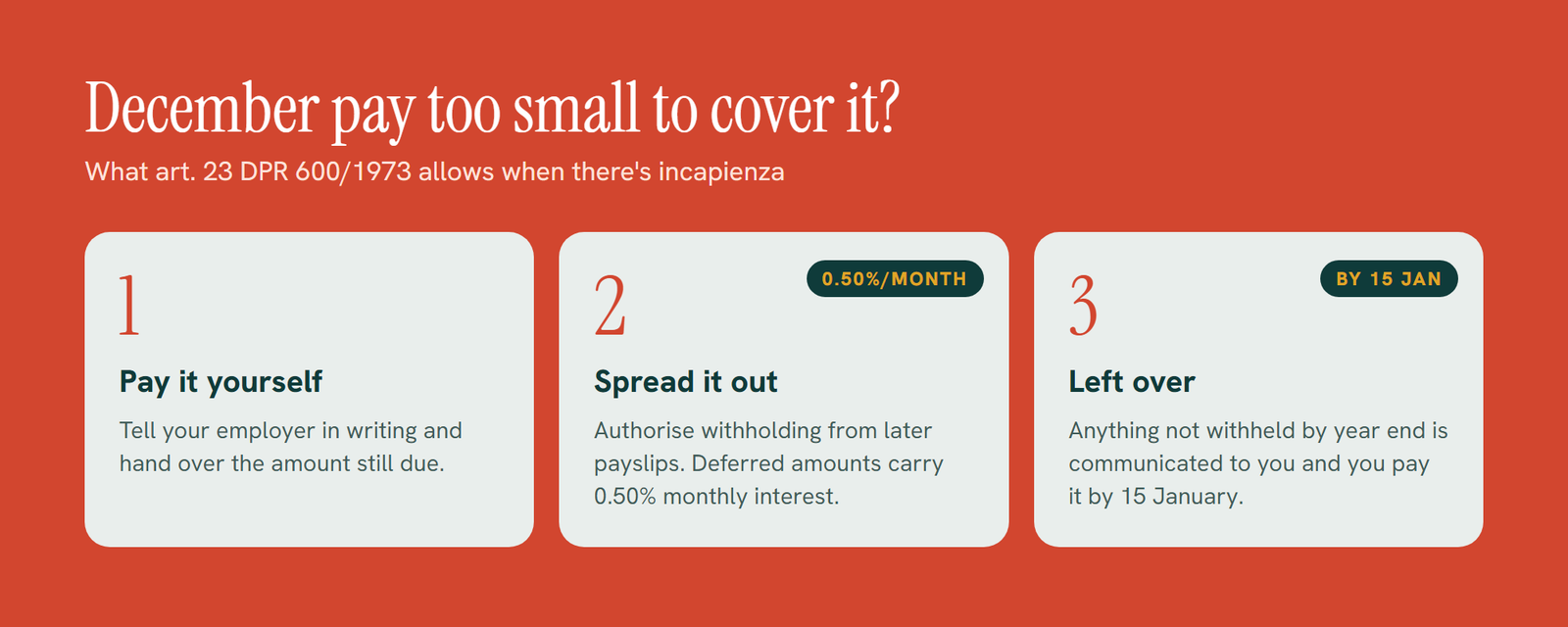
Sometimes the amount to recover is bigger than the December pay can cover. The law calls this incapienza, and art. 23 gives you two options:
| Option | How it works |
|---|---|
| Pay it directly | You tell your employer in writing that you’ll pay the remaining amount yourself. |
| Spread it over later payslips | You authorise the employer to take it from later pay periods. Deferred amounts carry interest of 0.50% per month, withheld together with the tax. |
| Not recovered by year end | Anything the employer couldn’t withhold (for example because your job ended) is communicated to you, and you must pay it yourself by 15 January of the following year. |
The interest is small. Spreading €300 over three months costs €4.50 in interest, for example. But it’s worth knowing it exists before you agree to spread a large amount.
The Addizionali Are Separate
The conguaglio also works out your addizionale regionale and comunale for the year, but those are not taken in December. The balance is withheld in instalments from January to November of the following year, and the comunale advance for the new year starts in March. That’s why your payslips in the first months of the year can look slightly lower too. Our guide to trattenute in busta paga explains each line.
How to Avoid a Bad Surprise in December
- Tell payroll about changes to your family situation as soon as they happen, so your detrazioni per familiari are right all year.
- Expect a debit after a big bonus or arrears, especially if it pushes you over €28,000 or €32,000 of income.
- Two jobs? Give your current employer the CU from the earlier job if you want it included. If you don’t, the extra tax is usually settled later in your 730.
- Check your December payslip line by line. The conguaglio is usually shown as a separate IRPEF line, sometimes labelled “conguaglio IRPEF” or “IRPEF a debito”.
The calcolatore stipendio netto on our homepage shows your normal monthly net pay, so you can see how much of a December difference is the conguaglio. For how the tredicesima is taxed, which also lands in December, see our post on the tredicesima netta.
Disclaimer e Fonti
This article is general information, not tax advice. Your employer’s payroll office and your CU are the final word on your own conguaglio. Sources: art. 23 DPR 600/1973 (conguaglio, incapienza, interest and deadlines); art. 13 TUIR (detrazioni lavoro dipendente); L. 207/2024 art. 1 commi 4-9 (cuneo fiscale); Legge 199/2025 (IRPEF brackets 2026); INPS circolare 6/2026 (contributions). Figures checked in October 2026.